Showing posts with label quilting. Show all posts

Thursday, May 31, 2012

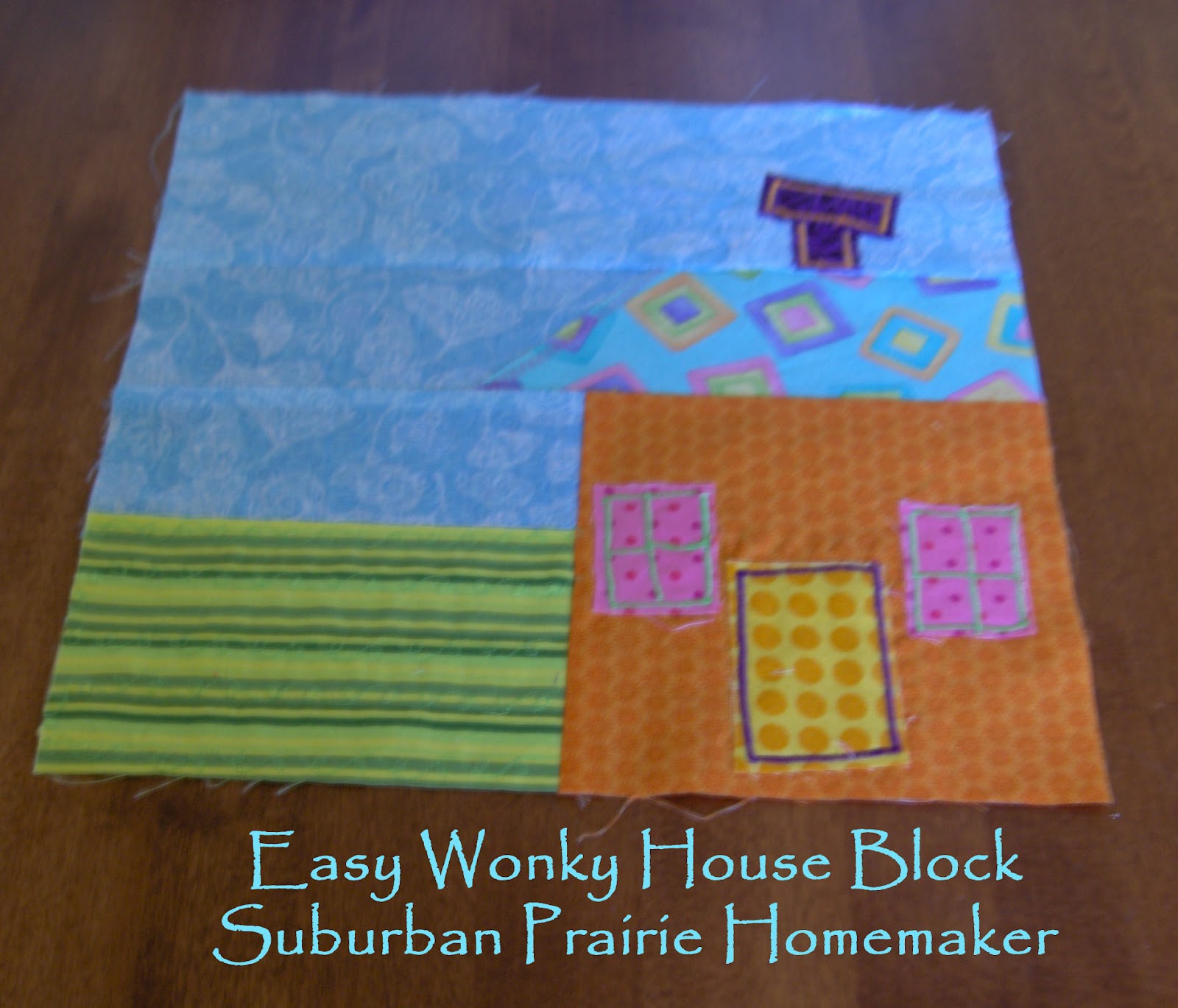
One Yard Wednesday - Easy Wonky House Block Tutorial

A lesson in patience and OCD Management today...


Made these for a SWAP on Mary Jane's Farm Girl Connection.  Sounded like so much fun.  Fabric piecing as folk-type art - how totally cool, right?  Wrong.

I read tutorial after tutorial online.  They all involve using odd-shaped pieces from your stash and some piecing that is just so tiny that these poor over-40 eyes would be crossed indefinitely.  And then, of course, the OCD kicked in.  How wonky is too wonky...

So using a suggestion from my farm girl sisters, and their prayers for patience and persistence, I made the cutie pie you see above.  Well, actually I made 6.  Because these are for a SWAP.

Since you, my dear reader, have practiced patience as well, waiting for this tutorial today, let's get started!

You will need graph paper, a ruler, a pencil and eraser.  For big erase jobs, which this had the potential to be, I always use my Pink Pearl instead of the eraser on my pencil.  Saves that little guy for when he's really needed.   You will also need fabric scraps that are big enough to make sky strips, a roof strip, and a house square.  Anything else can be made from mismatched teeny tiny bits from your stash.

For the six 12" blocks that I made, I used 1 yard of blue print for the sky strips, 1/2 yard of the orange to make the houses, 1 fat quarter of the roof color, and probably about a fat quarter to make the grass strips.  The rest was all little bits from my stash for the doors, windows, and chimneys.  And I mean little bits - like doors that are approximately 2" x 3", and windows that are 1" x 2".  The chimney pieces were 1/2" x 1" and 1/2" square.  Like I said, little bits.  You will also need a cutting mat, quilting ruler and rotary cutter.  Or at least a regular ruler and scissors.  And sewing things like a machine and thread.

The funnest part about the wonky house block is that everything can be random.  Throw everything we've talked about for color matching and coordination out the window.  If you like a certain bright purple next to something else, use it.  Pretend you are a kid, and you are drawing an imaginary house.  And you get to color in that picture with fabric.  If you are a totally free spririt and can just start stitching, go for it!

If you are OCD like I am, read on!

Mark out a square on your graph paper that will be a scale sketch of your finished block.  I have 1/4" graph paper, and used 1 square to equal 1/2".  I made a square on the graph paper that was 6 inches, then added a single row of squares all the way around to accommodate the 1/4" seam allowance.  This represented my 12 1/2" block.

This is when you start adding the features you want in your "drawing".  I started with the house - that's supposed to be the main feature.  For my first sketch (the one that drove me absolutely nutso), I had a house with an odd-shaped roof, and I even tried to do hills and trees.  Then I tried to mark it out to do the piecing, so at least I'd have a road map of how I was going to piece it all together.  It was a mess.  A nightmare!  Imagine cutting pieces 5/8" x 4 1/4".  And really goofy angles that I don't think I could cut.  Let's just say, that this was way more than I bargained for, and certainly not the fun, creative project I had anticipated.

So I got smart.  For my second house, which is the one we're using today, I put my house in the bottom right corner as an anchor.  Then I added two strips that would be the sky and the grass under the roof.  Both straight and simple rectangles, I might add.  The roof, and Sky #2, would be somewhat equal in size, with a simple 45-ish degree angle connecting them.  To top everything off, Sky # 3 would be a simple strip, height needed to make measurement and width of the block.  See?  Much easier!

Here's what I ended up cutting:
Orange (house base) - 7" square
Green stripe (grass) - 6 1/2" x 4 1/4"
Sky #1 (between grass and roof) - 6 1/2" x 3 1/4"
Sky #2 (attaches to roof) - 3" x 8"
Sky #3 (top) - 13" x 4"
Roof - 8 1/2" x 3"


Even after making the blocks, these are still rough measurements.  Feel free to use whatever measurements you want for your block.  The trick is to make certain sections the same height, then cut them to the correct width of the block when you are all done.  When you square up your block at the end, it may end up a different size than you anticipated.  And that's ok, too.

Section 1 is what I called my base.  It's the house, grass, and Sky #1.  Start by stitching together the sky and the grass, then pressing the seam toward the grass.  Line these up with the base of the orange square and stitch, press, and trim if needed.  By the way, use 1/4" seam allowances throughout.  It should look like this:

Next up is attaching the roof to the sky.  Start by cutting the ends of the roof piece to roughly 45 degrees.  I just lined up my ruler with the bottom corner and angled it up and to the right.  It was close enough for me.   (and that's ok), use the lines for these angles on your quilting ruler.If you really need a 45-degree or 60-degree angle, use the lines on your quilting ruler to help you get the angle that you need .

This is what we end up with.


Now, we overlap!  Lay the angled piece over the straight piece, lining the top point of the angled piece up with the top right corner of the straight piece.  Stitch along the angled edge.  Use pins if you need to - I didn't.  I also used a hot pink thread (just for fun) and a zig zag stitch.  You don't have to use hot pink, but I do recommend the zig zag stitch. This is called raw edge applique, and by using the zig zag stitch, you help stabilize the fabric.  Plus it looks cool.  It's a way to add a little fun detail, even if you don't have a big fancy machine.

Fold the roof section back across the sky section, and trim to leave a 1/4" edge behind your sewing.  This eliminates the extra bulk from the center of the block.  Bulk is not a good thing.

Stitch this strip onto the house section, matching the right roof edge with the top right house edge.  Press the seam toward the house.

Trim as necessary.  Then, sew on the last sky strip.  Press the seam toward the top sky strip, and trim if necessary.  Use scraps to make the windows, door, and chimney.  I used a decorative stitch to attach mine, but you could use a plain zig zag.  You will also notice that my front door seems to float.  Remember our 1/4" seam allowance?  When the recipients stitch their blocks together, I didn't want my doors to get caught in the seam.  Again, that bulkiness issue thing.

Here are all 6 of them together.
You can easily make a whole bunch of these over a weekend and do a table runner or small quilt.  How perfect would these be for a child?!  Feel free to add borders around the blocks.  Add outside borders.  Or not.  Make them smaller.  Make them bigger. Make them all different sizes with different borders.

Tap your inner wonkiness, and make some this weekend!  Have fun!


Wednesday, March 14, 2012

BONUS OYW - Mini Quilt Mug Mat

Our schedule got a little off kilter with the TV appearance, so here's a BONUS One Yard Wednesday - something else to do with those little tiny scraps plus two new techniques...


I found some wonderful fun greens and the orange plaid in the scrap bucket.  Orange, white and green are the colors of the Irish flag, and what better way to add some St. Paddy's flair to your morning cuppa Joe?!

So grab those leftover tidbits of jelly roll strips, or border pieces, or other oddments that you have, some leftover cotton batting.  The batting MUST be cotton (you'll see why in just a bit) - if you don't have any, use a piece of an old towel.  You will also need a piece of plain fabric to put your pieces onto.  You can use muslin or other scrap fabric.  I used a bit of that green sheet I still have left over.  I am beginning to think I will be sewing with that sheet until the end of time, but I digress...


Press your scraps.  Then, cut your backing fabric, your batting and your base fabric into a 6" x 9" rectangle.


Layer these with your backing fabric face down (wrong side up), then batting, then the base fabric.

Now the fun really begins!  On top of your fabric sandwich, place one of your strips right side up.  Place another strip on top of the first, matching the side edges, face down (right sides facing).  This is first of the new techniques - it's called quilt as you go, and it's another real time saver.  Pin through all layers.


Using a 1/4" seam, stitch the two strips together  - yes, through all the layers.  You have now not only started your mug mat, but you are in the process of finishing it, too.  You are quilting as you go.  See how this works?!  Pretty cool, huh?!

And this is why you need cotton batting.  Open the fabric strips and press the seam.  If you used polyester batting, it would melt.  After pressing, add the third strip.
You'll notice this time I didn't line up my edges.  That's ok.  This doesn't have to be super precise.  Again, stitch with a 1/4" seam allowance, and press.

Repeat until you use up all your strips.
Trim everything up, and make sure to square up your edges.  You can stop right now if you want, and add some binding.  Your mug mat is already quilted.  Feel free to play a bit more, though, and have some fun.  This is one of the few occasions that I actually use matching thread in the bobbin (usually I just use white).  I wanted green thread on the back so it would look nice, like the front.  Use a thread that matches or contrasts the backing fabric - whichever you want.

I used a stipple stitch on the multi-color dot fabric section - to me it makes the dots look like confetti.  Then, I just did a simple S pattern on the dark green.  I did "stitch in the ditch" on the green squares (you stitch in the space where the seam is sewn), then went back and added the horizontal lines.  For the green and white dot, I just lined up my presser foot to go between the rows of dots, and went both directions to get the cross-grid pattern.  Here's how that turned out:
Remember, you can add this stitching to the fabric first (thread painting), if you want the pattern but you don't want your quilting to look that way.  If I had it to do again, I would not have quilted the dark green section.  Or I would have used a dark green.  Either way, you can see that you can quilt your mug mat in many different ways.

Here's the quilting on the back.
I could easily have used a yellow or darker green thread, but I think the bright green blended into the fabric better.  Sometimes, you just get lucky that way.

So let's finish this baby off, shall we?

When you make a quilt, you need some way to finish off the raw edges on the sides.  In this case, we'll use binding.  We've made binding before, for another mug mat, back in January.  We're going to do things just a bit different this time, but the principle will be the same.

You will need two strips of fabric.  I cut mine at 1 1/2".  Each piece was also 22" long.  Remember when we measured our fabric scraps yesterday for the table runner?  Also, we're going to do some more geometry to get the perimeter of our mug mat, to be sure we have enough fabric to go all the way around the little thing.  A 6" x 9" mug mat has a perimeter of 30".  I'm safe with my two strips at 22" long.  I just seamed them together (matching the plaid), with a 1/4" seam.  I pressed the seam open.  Then I folded this new long strip in half and pressed it.
Now, normally, on quilt binding, you would fold the raw edges into the middle and press again.  I didn't want to do that in this case.  I liked the casual, folk art element a raw edge added to my mug mat.  Fold or don't fold - you decide.  To apply the binding to your mug mat, on one of the short edges, fold the end under about 1/4".  Slide your little quilt in between the layers of fabric of the binding.  Pin the beginning of the binding to the quilt.
So here's the next new technique today:  a mitered corner.  About 1/4" from the corner, pleat your binding, so it makes a slight angle.  Like the mitered corner on a picture frame.  Pin.
If you are using a plaid, try to get your lines to match up.  That's one of those little details that makes the difference between homemade and handcrafted.  It's hard to see, but the little blue line actually does match up.  Repeat mitering and pinning all the way around.  When you get back to your starting place, leave a bit of a tail to overlap, and cut the loose binding.
Again, I made sure to match my plaid.  Fold the end under about 1/4" and pin to secure.  You can see in the photo that I had already started to stitch my way around.  This was purely to give you a better picture sans pins.  After you get your binding secure all the way around, THEN start stitching.  You know the drill - straight, zigzag, decorative - all your choice.  Thread - matching or contrasting - all your choice.  I used the same bright green and a cute cross-stitch.

Let's play the options game again!  YAY - it's one of my favorites.  It's a chance to show you how far outside the box you can actually go and still have something turn out well.  Let's start with fabrics.  I did greens and the orange/green plaid for St. Pat's Day.  You can use themed fabrics for any holiday.  Or traditional holiday colors.  Use someone's favorite colors for a special occasion (think mother/sister-in-law, neighbor).  How about school colors for a new high school grad heading off to college?  Embellish a corner with a monogram.  Or a cute button.  Just be sure to leave a space for the mug!

What about shape?  How about squares instead of rectangles.  Use them for coasters.

What about size?  Use the quilt-as-you-go technique on placemats.  Or a table runner.  Or a wall hanging.  Or even a baby quilt.  The technique works best with straight-edged geometric shapes and strip piecing.  But there are no rules that say your strips have to be exactly rectangular.  Give your piece a real modern flair by using those "wonky" bits of fabric.  Or use a quilt block that has a circle in the center, then strip piece around that block.  Overlap pieces, but leave raw edges.  Wow, now you're really walking on the wild side!

What about repurposing?  I mentioned using old towels for batting above.  But what about using old blue jeans for the quilt piecing.  Or cotton dress shirts.  Any cotton fabric will work.

Play with your scraps today, and have FUN!

Photobucket

Monday, February 20, 2012

March Quilt-Along

Just got a WONDERFUL new catalog from Connecting Threads this weekend.  In March, to celebrate National Quilting Month, they are hosting a quilt-along, complete with tutorials.  The patterns will be free, the tutorials will be free, and signing up is free.  Go to their website and sign up for their free emails, and you will be able to get the info, right in your inbox.

I'm going to participate and share my progress here.

Hope you'll quilt along with me!

Photobucket

Monday, January 16, 2012

Tea for Tuesday - Snowflake Mug Mat

Another mug mat - this one is sewn.


Here's what you'll need:

  • Scraps of fabric in 2 shades of blue and white (each piece needs to be big enough to accommodate a 6" circle,  the dark blue needs to be big enough to also cut a strip 2" wide x 18" long, and the white needs a small piece leftover from which to cut your snowflake)
  • Fusible web (aka Heat-n-Bond)
  • 1 scrap piece of either quilt batting or fleece fabric
  • Sewing supplies - including pins (I know - I said pins.  Really, I'm feeling fine.  You'll see why you need them in a minute)
  • Iron and ironing board


You need to print this template first.  Right click the image and select "Copy image".  Open either photo-editing software or PowerPoint.  Paste the template into a new document.  Drag the corners of the image until it fills a full, regular size piece of paper.  Then, print.

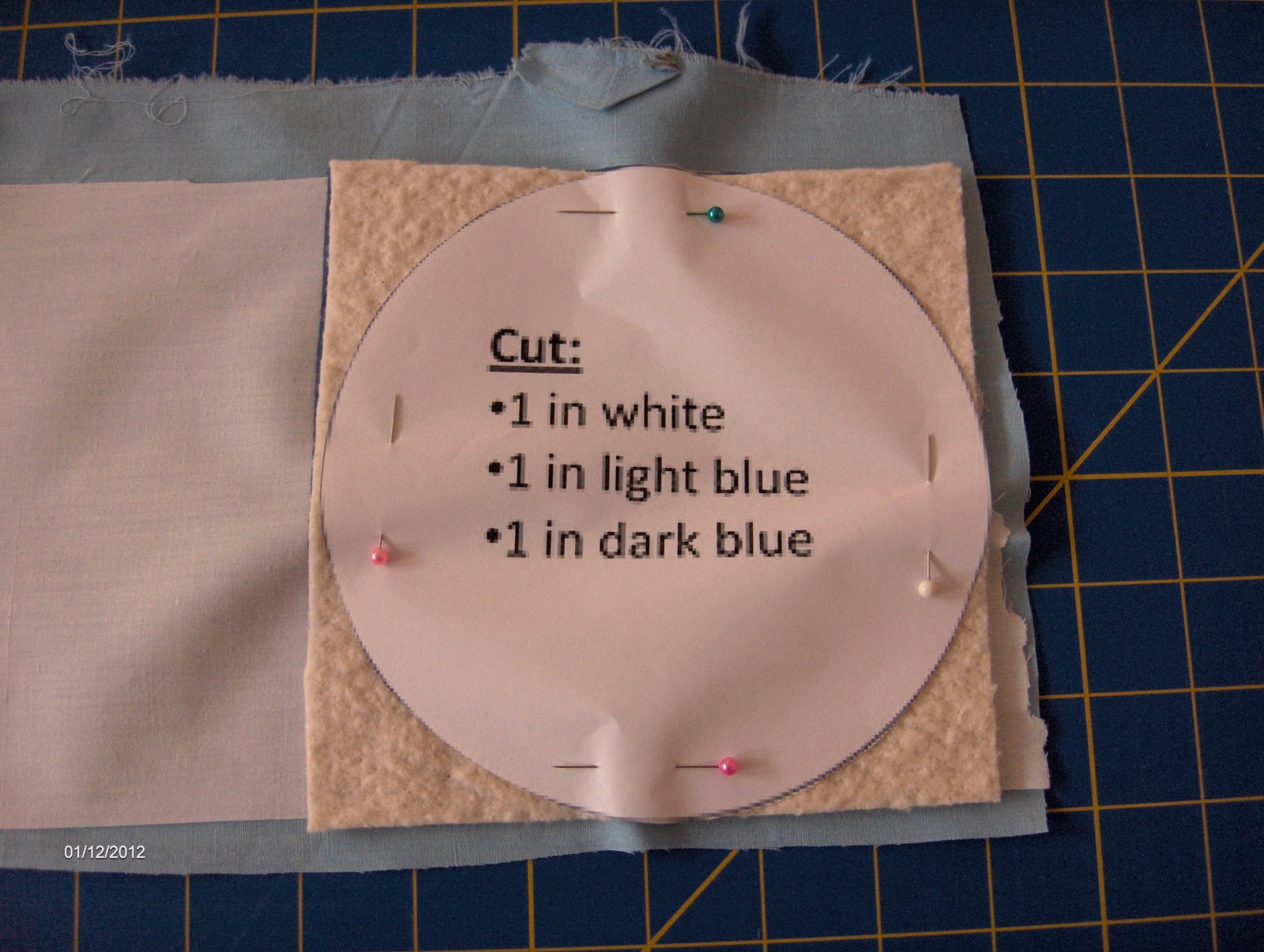
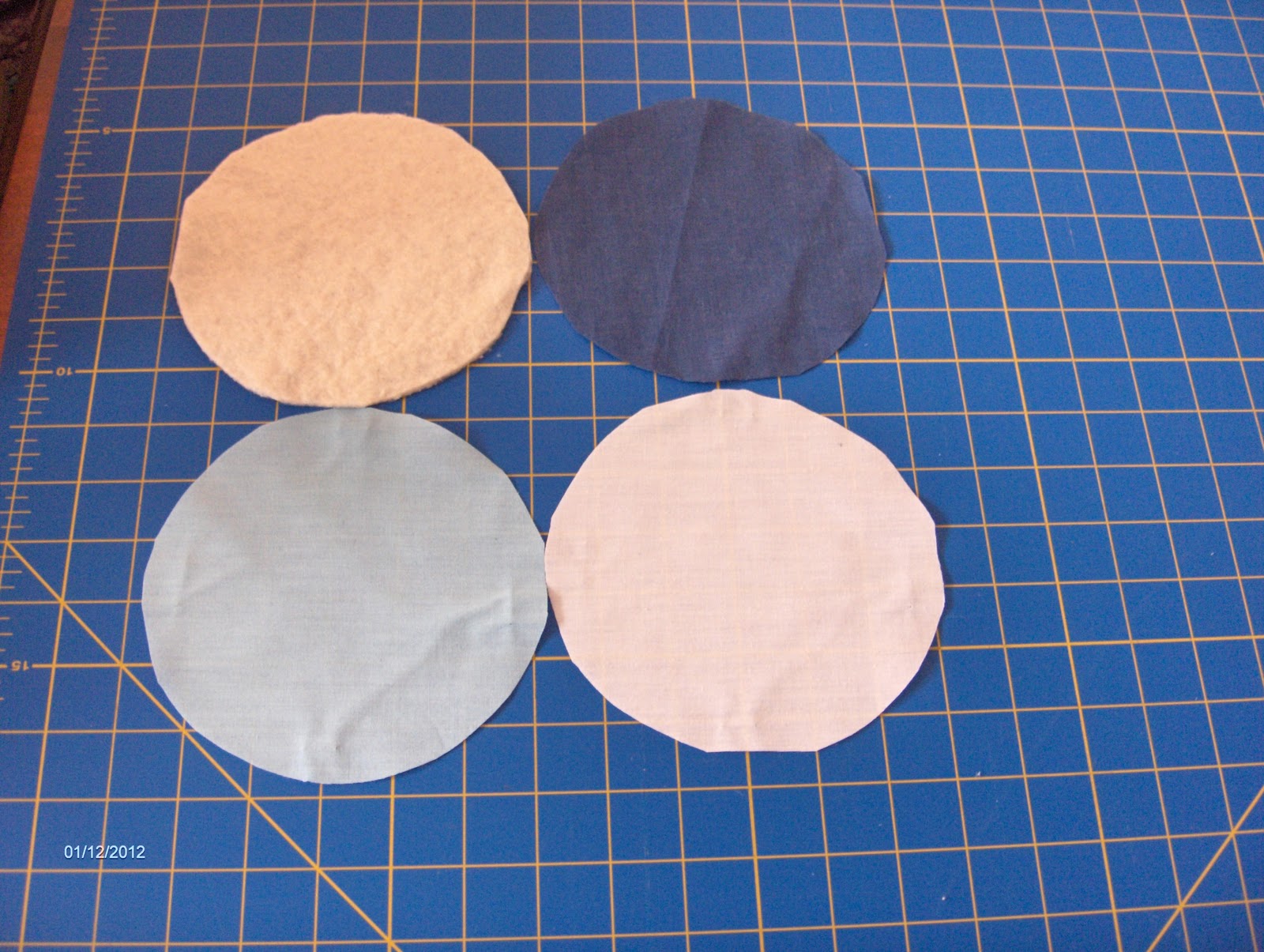
Let's cut the circles next.  Layer your three colors of scraps and your batting.  Place the big circle template on top, pin and cut.


To make the snowflake, cut out the smaller paper circle.  Trim off the outside wedges between the points.  Fold in half.  Try to line up your points before making this fold.    Then, fold each of the points in half again on the solid line.  Cut out the little diamonds.  Trace your snowflake onto the paper side of your fusible web.  Press it onto the remaining white fabric scrap per package directions. 

Cut it out.  I followed the same steps to cut it out this way as I did for the paper template.

Press your new snowflake onto the light blue circle per package directions.  Remove paper backing.


Layer light blue circle, batting, and white circle.


Pin layers together.  Using your choice of stitches, sew around outside edges of snowflake.  This will not only help secure your applique, but also give the top that quilted look.  You can use a straight or zigzag stitch, or a decorative stitch.  You can also choose whether to use matching or contrasting thread.  Maybe even a metallic thread if you are so inclined.  
Sew inside the little holes.  It may seem a bit tricky at first.  I just lifted my presser foot and went to the little space next to the one I just finished.
Clip your threads.  Then, if desired, quilt between the points of the snowflake.  I did.

Make your binding from the 2" strip.  Use the method we used for the straps for the Little Dresses on Saturday.  Layer your mini snowflake quilt with the dark blue circle on the bottom.  Carefully pin the binding over all the layers around the edge of the circle, folding under the cut ends a bit to prevent unravelling.

Stitch in the center of the strip to secure.  Again, straight or other stitch is your choice.  I used one on my machine that kind of looks like little snowflakes.  Thread color is also your choice.

And speaking of color choices...

How cute would these be on a Christmas plaid with either green or red binding?  How about a metallic snowflake?  What if you'd like a snowflake that's a different shape?  What about hearts for St. Valentine's Day, or a clover for St. Patrick's Day?

Put on your crazy creative hat and have some fun!  


Wednesday, January 11, 2012

One Yard Wednesday - A Ray of Sunshine

A cute little bag in bright sunny yellow - to cheer the drear, and haul the keys.  And the cell phone.  And the wallet. Or maybe your lunch?  For only a yard of fabric.


Sorry - sideways photo.  Everyone please lean left.  Look how fun - polka dots!  Flowers!  Rick Rack!

A tutorial today, complete with photos AND diagrams.  Wow - slick!

So here's what you need:
1/2 yard Fabric A for the exterior and inside pockets (JoAnn Fabrics)
1/2 yard Fabric B for the lining (Connecting Threads)
Both should be cotton fabric, and approx. 40+" wide.
Sewing tools - pins, scissors, rotary cutter & mat, thread, etc.
One length of large rick rack, color of choice, cut to 20"

This is how I started - just an idea doodled onto some scratch paper:
Then I got a little more serious, and decided to map it out on graph paper.  And I have some really big graph paper!
I doodled some more and measured and listed my objectives for this project, like the fabric requirements, and all my other ideas I wanted to incorporate.  Then I sketched some more.
And here's how it all works out...

From each fabric cut:
1 strip 2 1/2" x width of fabric
1 piece 18 1/2" x 10 1/2"
Also, 1 strip from Fabric A 4 1/2" x 18 1/2" (feel free to change the 3 1/2" measurements to suit your tastes.
You can also cut a piece of Fabric B to a desired size to make an outside pocket (or pockets).

There is a 1/4" seam allowance throughout.  Not sure where that 1/4" is on your machine?  Use your general purpose sewing foot, then use the right edge of the foot as your guide.  That's what I use for most things that require 1/4" seams.  If you are doing precision piecing on a quilt, where that 1/4" is the difference between a really nice quilt, and a knock-your-socks-off quilt, put both the needle and presser foot down.  Then, lift just the presser foot.  Line up a small ruler with the needle, and make a guideline on the throat plate with painter's tape at the 1/4" mark.  Use the really skinny painter's tape - you may have to buy it at a paint store.  Don't worry, it's not that expensive.

Finished bag is roughly 6" x 3" x 10".

Fabric A is on the bottom here, and Fabric B is on the top.  I trimmed them both to 18" to meet the 1/2 yard measurement.  Like I said the extra fabric can be used for pockets on this bag or another project, used in a scrappy quilt, etc.

After you cut your pieces, you will press all 4 edges of the pocket piece down 1/4" and straight stitch them into place.

Next you will make your straps.  With right sides (the printed sides) together, stitch up one long side, across the one short side, then back down the other long side.  This makes a great big tube. You will need to turn it right side out.  You can do this one of two ways.  I used the end of a knitting needle.

Separate the layers at the short end, then tuck the head of the knitting needle into the little pocket that this makes.  Push the needle and pull the fabric back up over it, until all the fabric is reversed.  Then line up your seams as best you can, and press it flat.
The other way to do this:  Sew a long piece of string THROUGH the short end at the top.  Since I don't have a photo, here's a diagram:
Put a little tail of the string in between the two pieces of fabric, then drape the long end of the string out the back.  Pins here are generally helpful.  The sewing method is the same - up one long side, across the short end and string, and down the other long side.  To turn, pull the string.  After the strap is turned, simply clip the string as close to the seam as possible without cutting the actual seam.  Clipping corners - also good.  For this type of project, I will use this method next time.  Use whichever way works best for you.

Cut the strap into 2 pieces of desired length.  My two pieces were about 18" each.  Sounds really long, I know, but remember, they will be folded in half when placed on the fabric, and you also will lose another 1/2" in seam allowances.  Make your straps longer or shorter.  I'm going to try shorter next time.

So on to the pockets!  Line up your pocket strip on the 18 1/2" x 10 1/2" rectangle of Fabric B.  It should be centered vertically and lengthwise.  Another diagram here:


Stitch bottom edge into place to secure.  No need for seam allowance here, just topstitch over your previous sewing.

More measuring and marking here.  We will start from the left side and work our way to the right.  The sides of the bag are 3", and we've allowed room for 1/2" in seam allowances.  From that left edge, measure 1 3/4" and put a pin in the top edge of the pocket strip.  Trust me, it will all work out.  This section makes what I'd call pen/pencil pockets (or lipstick pockets if you are so inclined).  From that pin, measure 6" and put in another pin.  Measure 3" and put in another pin.  Measure 6" and put in another pin.  Finish up by pinning the last corner of the strip to the main body of your soon-to-be bag.  Do the same measuring and marking on the rectangle of Fabric A at the top of the rectangle.  You'll see why in a bit.

Back to the pockets.  I lined up my presser foot with the pin, lowered the foot, then slid the pin out the back.  Use a reinforcing stitch (forward a little, back to the beginning, then forward again) at the top and bottom of your seam to ensure your pockets don't rip out the first time you put something in them.  Repeat this step for all the pockets.  When you are all done, press the top edge of the main piece down 1/4" toward the wrong side (the back).

Next we'll add the straps to the outside of the bag.  This is why we went ahead and measured and marked our sides.  On the 6" sides of the bag, center the straps with the cut edges at the top, and the straps looped. Like this:
Use your imagination for the looping part.  Be sure when you place your strips that the fabric you want to show is on the outside of the loop.  If you want your straps to match the outside of the bag, put the Fabric A side out.  If you want them to contrast, put Fabric B on the outside.  Stitch them into place, and definitely reinforce the stitching.  After the straps are stitched in place, press the top edge of the rectangle, strap edges and all, down a 1/4" toward the wrong side (the back).

Now we are going to turn these pieces into bags.  Fold each rectangle in half with the short edges meeting.  Pin if desired.  Stitch along the edges marked by the arrows.
Do this for both rectangles.  Press side seams open as much as possible.

Line up your quilt rule with each bottom corner so that you have a 2" square marked.
Mark this square (I used a pencil), then cut out.  Do the same thing on the other bottom corner.  Repeat with the other piece.  I add a row of reinforced stitching to the bottom edge, just for security.  Then trim the fabric as close to the stitching as possible, without going THROUGH the stitches.
Find the inside cut corners of the open squares.  Pull the bag open by pinching at these corners.  Line up the cut edges and pin.  Repeat on the other side.  Make sure your center seam faces the same direction.  Repeat for the other piece.
It's ok if it bunches a little bit.  Try to make fabric even.  This is called easing.  Usually, you do this in a sleeve.  Stitch in place, using a 1/4" seam.  Be careful to remove your pins as you sew.

Let's put this baby together, shall we?  Turn the piece with the straps RIGHT SIDE OUT.  Leave the other piece with the WRONG SIDE OUT.  Insert your lining into your bag, matching the side seams, and pushing out bottom corners to shape as you go.  
Home stretch!  Now we are going to put the rick rack between the layers, and pin everything together.  This is the end of the rick rack.
Fold the cut edge under about 1/2", so it matches the wave above it.
And now, WE PIN!  Match this folded edge with the side seam of your bag.  The cut-edge-side should be facing the lining.  Pin in between the layers of the bag.

Continue pinning all the way around, going behind the straps.  This is what is will look like when you get all the way around.
Carefully stitch all the way around the top edge.  I used a decorative cross stitch - not just for looks, but also for reinforcement.  I also used a yellow, matching thread.  You can use a straight stitch, zigzag, or contrasting thread.  Whatever your heart desires.

If you want something more stiff and sturdy, you can add stabilizer.  Or quilt it with some batting.  Make it with a bunch of fat quarters and scraps.  Use leftover jelly roll strips for the handles.  Make it all one color.  Make it without rick rack.  Make it from repurposed men's dress shirts or old blue jeans.

Use your imagination and your stash, and have fun with it!

And PS - if you make one, please leave a comment - I'd love to hear about what you made!