Showing posts with label sewing. Show all posts

Wednesday, September 25, 2013

Anthro Inspired Skirt Tutorial

So here's the tutorial I promised...

To refresh everyone's memory, I found this late last fall, and said "I HAVE to make one!"  She is beautiful, no?!


This is the piece I entered back in February for Creative Bloggers Got Talent, and today I'm going to show you how to make one for yourself.

I bought a pattern for $1.65 (on sale and with teacher discount), made a base template from muslin (leftover from another project - you could use a repurposed bed sheet), and repurposed denim from blue jeans.  I think I paid more for the zipper than anything else!


Photobucket

Thursday, May 31, 2012

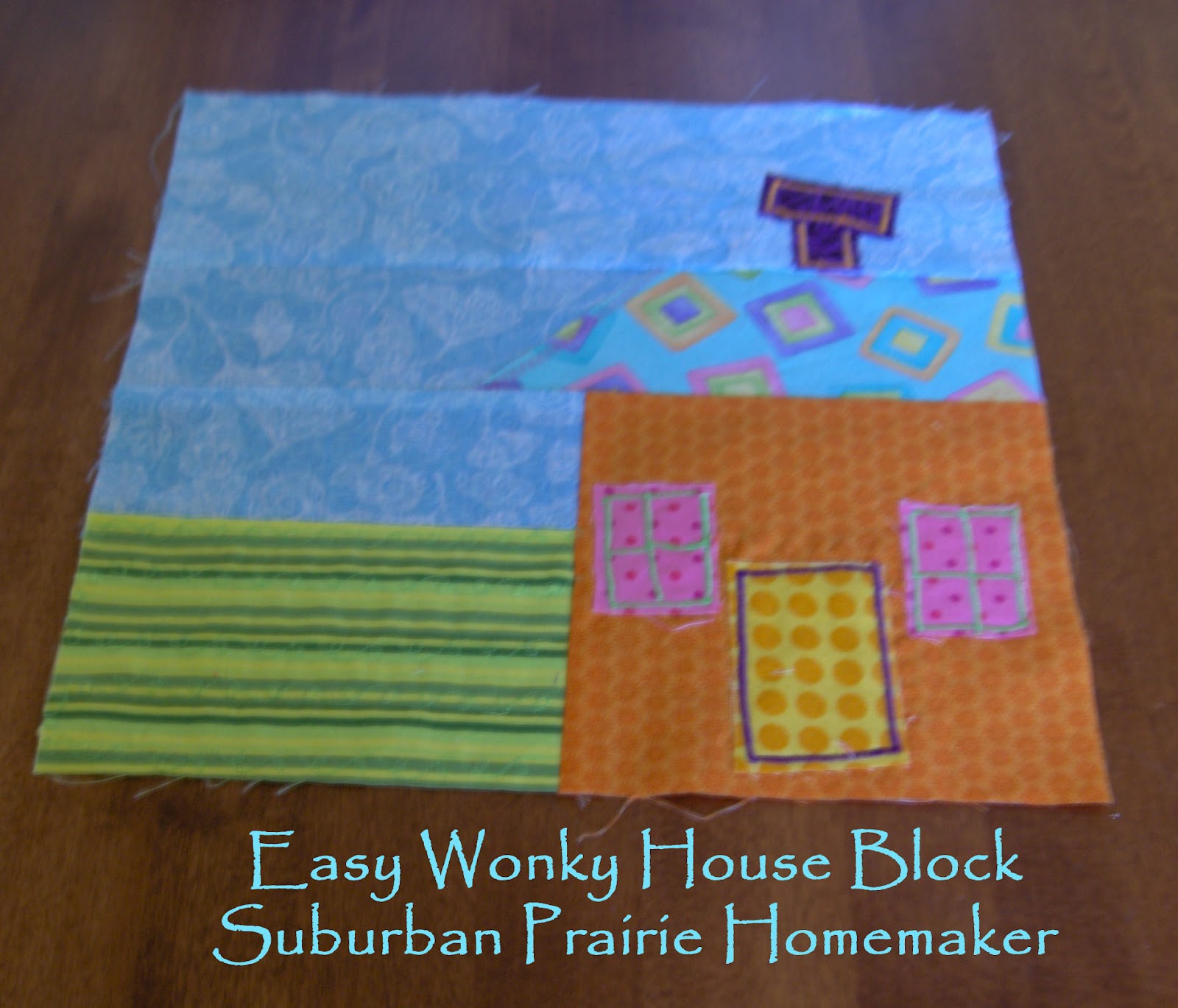
One Yard Wednesday - Easy Wonky House Block Tutorial

A lesson in patience and OCD Management today...


Made these for a SWAP on Mary Jane's Farm Girl Connection.  Sounded like so much fun.  Fabric piecing as folk-type art - how totally cool, right?  Wrong.

I read tutorial after tutorial online.  They all involve using odd-shaped pieces from your stash and some piecing that is just so tiny that these poor over-40 eyes would be crossed indefinitely.  And then, of course, the OCD kicked in.  How wonky is too wonky...

So using a suggestion from my farm girl sisters, and their prayers for patience and persistence, I made the cutie pie you see above.  Well, actually I made 6.  Because these are for a SWAP.

Since you, my dear reader, have practiced patience as well, waiting for this tutorial today, let's get started!

You will need graph paper, a ruler, a pencil and eraser.  For big erase jobs, which this had the potential to be, I always use my Pink Pearl instead of the eraser on my pencil.  Saves that little guy for when he's really needed.   You will also need fabric scraps that are big enough to make sky strips, a roof strip, and a house square.  Anything else can be made from mismatched teeny tiny bits from your stash.

For the six 12" blocks that I made, I used 1 yard of blue print for the sky strips, 1/2 yard of the orange to make the houses, 1 fat quarter of the roof color, and probably about a fat quarter to make the grass strips.  The rest was all little bits from my stash for the doors, windows, and chimneys.  And I mean little bits - like doors that are approximately 2" x 3", and windows that are 1" x 2".  The chimney pieces were 1/2" x 1" and 1/2" square.  Like I said, little bits.  You will also need a cutting mat, quilting ruler and rotary cutter.  Or at least a regular ruler and scissors.  And sewing things like a machine and thread.

The funnest part about the wonky house block is that everything can be random.  Throw everything we've talked about for color matching and coordination out the window.  If you like a certain bright purple next to something else, use it.  Pretend you are a kid, and you are drawing an imaginary house.  And you get to color in that picture with fabric.  If you are a totally free spririt and can just start stitching, go for it!

If you are OCD like I am, read on!

Mark out a square on your graph paper that will be a scale sketch of your finished block.  I have 1/4" graph paper, and used 1 square to equal 1/2".  I made a square on the graph paper that was 6 inches, then added a single row of squares all the way around to accommodate the 1/4" seam allowance.  This represented my 12 1/2" block.

This is when you start adding the features you want in your "drawing".  I started with the house - that's supposed to be the main feature.  For my first sketch (the one that drove me absolutely nutso), I had a house with an odd-shaped roof, and I even tried to do hills and trees.  Then I tried to mark it out to do the piecing, so at least I'd have a road map of how I was going to piece it all together.  It was a mess.  A nightmare!  Imagine cutting pieces 5/8" x 4 1/4".  And really goofy angles that I don't think I could cut.  Let's just say, that this was way more than I bargained for, and certainly not the fun, creative project I had anticipated.

So I got smart.  For my second house, which is the one we're using today, I put my house in the bottom right corner as an anchor.  Then I added two strips that would be the sky and the grass under the roof.  Both straight and simple rectangles, I might add.  The roof, and Sky #2, would be somewhat equal in size, with a simple 45-ish degree angle connecting them.  To top everything off, Sky # 3 would be a simple strip, height needed to make measurement and width of the block.  See?  Much easier!

Here's what I ended up cutting:
Orange (house base) - 7" square
Green stripe (grass) - 6 1/2" x 4 1/4"
Sky #1 (between grass and roof) - 6 1/2" x 3 1/4"
Sky #2 (attaches to roof) - 3" x 8"
Sky #3 (top) - 13" x 4"
Roof - 8 1/2" x 3"


Even after making the blocks, these are still rough measurements.  Feel free to use whatever measurements you want for your block.  The trick is to make certain sections the same height, then cut them to the correct width of the block when you are all done.  When you square up your block at the end, it may end up a different size than you anticipated.  And that's ok, too.

Section 1 is what I called my base.  It's the house, grass, and Sky #1.  Start by stitching together the sky and the grass, then pressing the seam toward the grass.  Line these up with the base of the orange square and stitch, press, and trim if needed.  By the way, use 1/4" seam allowances throughout.  It should look like this:

Next up is attaching the roof to the sky.  Start by cutting the ends of the roof piece to roughly 45 degrees.  I just lined up my ruler with the bottom corner and angled it up and to the right.  It was close enough for me.   (and that's ok), use the lines for these angles on your quilting ruler.If you really need a 45-degree or 60-degree angle, use the lines on your quilting ruler to help you get the angle that you need .

This is what we end up with.


Now, we overlap!  Lay the angled piece over the straight piece, lining the top point of the angled piece up with the top right corner of the straight piece.  Stitch along the angled edge.  Use pins if you need to - I didn't.  I also used a hot pink thread (just for fun) and a zig zag stitch.  You don't have to use hot pink, but I do recommend the zig zag stitch. This is called raw edge applique, and by using the zig zag stitch, you help stabilize the fabric.  Plus it looks cool.  It's a way to add a little fun detail, even if you don't have a big fancy machine.

Fold the roof section back across the sky section, and trim to leave a 1/4" edge behind your sewing.  This eliminates the extra bulk from the center of the block.  Bulk is not a good thing.

Stitch this strip onto the house section, matching the right roof edge with the top right house edge.  Press the seam toward the house.

Trim as necessary.  Then, sew on the last sky strip.  Press the seam toward the top sky strip, and trim if necessary.  Use scraps to make the windows, door, and chimney.  I used a decorative stitch to attach mine, but you could use a plain zig zag.  You will also notice that my front door seems to float.  Remember our 1/4" seam allowance?  When the recipients stitch their blocks together, I didn't want my doors to get caught in the seam.  Again, that bulkiness issue thing.

Here are all 6 of them together.
You can easily make a whole bunch of these over a weekend and do a table runner or small quilt.  How perfect would these be for a child?!  Feel free to add borders around the blocks.  Add outside borders.  Or not.  Make them smaller.  Make them bigger. Make them all different sizes with different borders.

Tap your inner wonkiness, and make some this weekend!  Have fun!


Tuesday, May 29, 2012

Tea for Tuesday - Free Mug Rug Patterns

Just a quick hello this morning!

There are several websites that I subscribe to that have free e-newsletters.  One of my favorites is AllFreeSewing.com.  Today's newsletter was perfect for Tea for Tuesday because it has a link to a list of free mug rug patterns.  So, I thought I'd share that list with you.

A great way to save money crafting is to find websites like this.  By using a free pattern, then using fabric or materials you may already have on hand, your wallet doesn't take such a hard hit when your creative juices are flowing!

Happy Tuesday!

Tuesday, April 24, 2012

Tea for Tuesday - Primitive Flower Mug Mat

A great idea for Mother's Day!


This is a really quick and simple way to learn how to do applique.  Our little mug mat is made from some simple squares of muslin and scrap fabric, a square of cotton quilt batting, and some scraps in bright colors.  You can decide how you want to shape your flower (I used an oval), your leaves, etc., and the colors you want.  I loved the combo of that funky pink with just a plain orange.  I also liked how the green made such a wonderful dark contrast to the brights.

You'll also need basic sewing supplies (including pins) and a sewing machine.

So let's all get started.  Cut fabrics and quilt batting to 6" square.  Dig through your scrap stash to find the color(s) you want to use for your flower and for the leaves.

Cut your flower fabric into desired shape(s). I used an oval and a circle.  You can use 2 circles, 2 ovals, a "standard" flower shape.  This is "primitive", meaning it can look like a three-year-old drew it.  Think outside the box!  Then, cut your leaf fabric into desired shape.  My leaves are just pointy ovals.

Pin the larger shape into desired position onto the muslin square.  Stitch it down with straight stitch, zig zag, or blanket stitch.  I used blanket stitch, and I also used an orange thread.  You can use matching, coordinating or contrasting thread - your choice.

Not sure which one is blanket stitch?  It looks kind of like this:


___|___|___|___|___|___|___|___|___|___


Set up your stitch so the flat side follows the outside edge of your item, and the up-and-down line points toward the center.  You may also have to adjust the tension on your machine to avoid puckers.  I should have loosened mine a bit.  If you're not sure, do a few test pieces.

If you'd like to really go vintage on this project, hand stitch the blanket stitches.

Repeat this process with the center for your flower.

Position leaves below flower, and repeat process.

Now, we are going to do the quilting part.  Make your mini quilt sandwich by placing the flower square face up on a table.  Then, place the backing square on top, wrong side (back) up, and place the batting on top of it.

Stitch around 3 sides, using a 1/4" seam.  Trim all 4 corners.  Turn right side out.


Turn edges of open side in towards the inside, about 1/4.  Pin closed.  Stitch around all 4 sides, close to the edge.

To quilt this, just use a straight stitch and go around the edge of the large part of the flower.  You can also stitch around the leaves, or do more quilting around each of the pieces, if you'd like.  I used hot pink to stitch the outside edge and around the flower.  Again, matching, coordinating, contrasting - the choice is all yours.

Make these in a bunch of color combinations.  Try soft, country colors.  Or more bolds and brights.  Or your gift-recipient's favorite colors.

Make these for any holiday or occasion.  Use a simple triangle for a Christmas tree, add rick rack or trims, or decorative stitches from your machine as decorations.  Make an oval from orange and a rectangle from green to make a pumpkin.  Add simple small black shapes to turn your pumpkin into a jack-o-lantern.  Think black half-circle with super thin black rectangle for a graduation cap.  Add a tassel for fun.

Be creative, and have FUN!

Photobucket

Tuesday, April 3, 2012

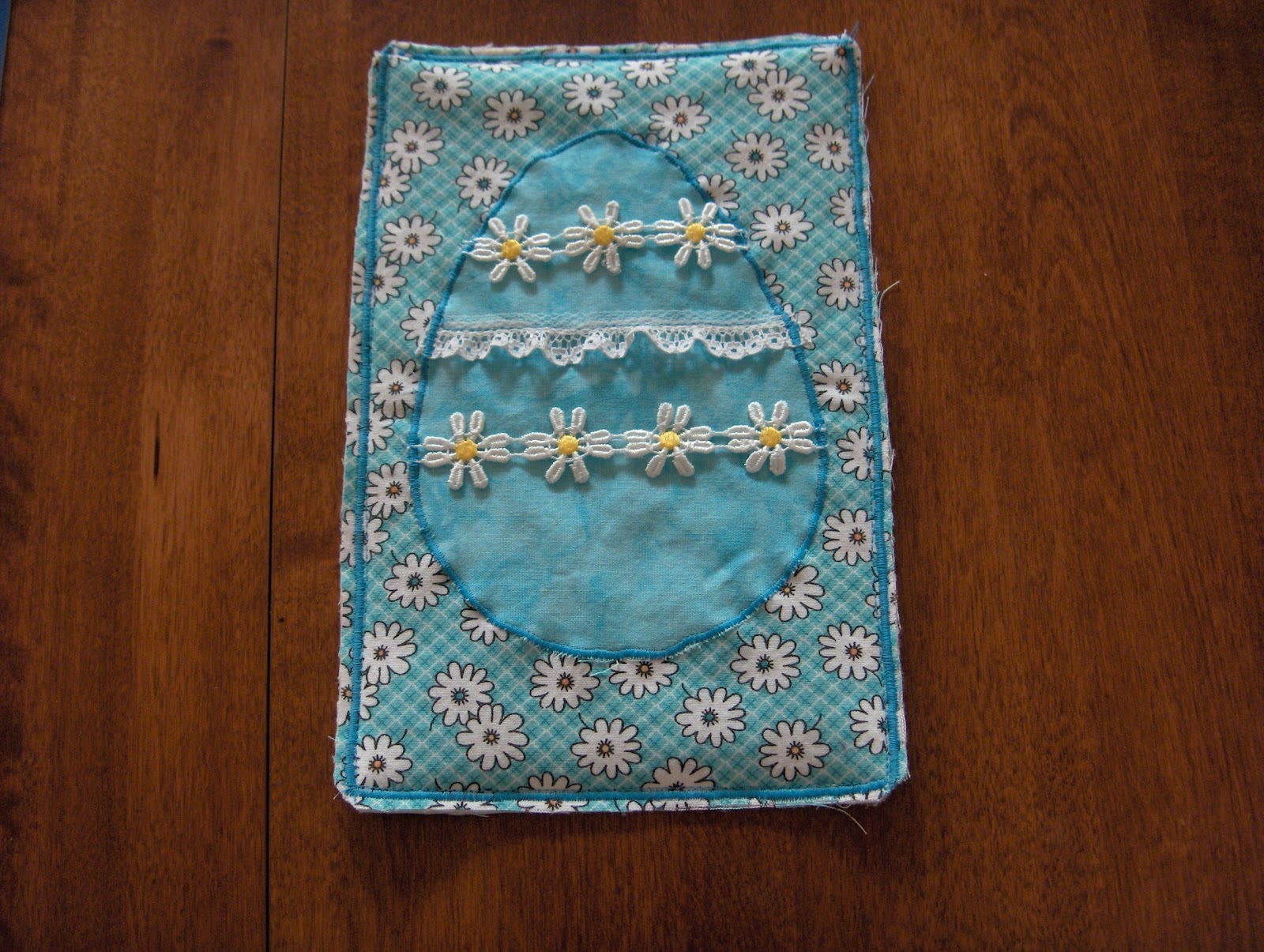
Tea for Tuesday - Easy Egg Mug Mat

All the fun of decorating Easter eggs without the mess...

I found this card online at Shoregirl's Creations, through a blog hop.  I love the simplicity of it.  If you are new to cardmaking, this is a great project for you to try your hand at.  If you are an experienced cardmaker, you will love the little details that make it so special.  She also has some AMAZING cards and crochet projects on her site, so be sure to go check it out when you are done with today's project!

I also thought it would translate to a different medium really well.  Wow - that sounds so technical!  In plain English - I could make it into/out of something else.  And I did.  I give you today's mug mat!


So here's how you take something you see as a card, a pillow, a whatever you see that you really like, and make it into or out of something else.  We'll start with the inspiration card.  This is a print out of the photo.

What drew my eye to this card?  I love the patterned background with the plain egg.  Usually you see a plain background with a jazzed up egg.  The big $10 word for that is juxtaposition.  Isn't that cool to say?!  Use it sometime to amaze and impress your friends!  I love the feminine touch of the lace and bow.  Makes it kind of vintage-looking, too.  I love how the egg is decorated with flowers.  Usually, eggs have stripes or dots - something more geometric.  The flowers also make it so much more Spring-y.  Since today is our Tea for Tuesday, and I'm on this total mug mat addiction trip lately, I thought the shape of the card in general would also make for a good re-do.  Mug mats can be any shape, but commonly they are rectangles.  Most importantly, it is a VERY simple design.  These are the BEST and EASIEST kind of designs to make into something else!

When you want to re-make something into something else, these are the things you should keep in mind, too.  In addition, think about the new version.  Can I make (THIS) out of (THAT)?  This would probably not make a very good woodworking project.  It could, however, work well with fabric.  In fact, in the inspiration piece, there is hand-drawn stitching around both the egg and the main body of the card, so that was a big tip-off.

So here's what you'll need today:
Scraps of a plain-ish fabric and a print.  My "solid" isn't really solid - it has a mottled appearance.  This type of fabric is usually called a texture, because it adds visual texture to a piece.
Scrap of cotton batting
Thread - choose matching, coordinating or contrasting (it's your egg)
Assorted trims - again your choice (use up what's in your scrap basket)
You can see that I'm keeping the floral element I like by using a floral background fabric and a floral trim.  The trim also mimics the lace.  The yellow centers of the flowers are also a great way to bring out the flowers on the background fabric that have yellow centers.

Press your fabrics, then cut:
1     6 1/2" x 9 1/2" rectangle of the patterned fabric
1     6 1/2" x 9 1/2" rectange from the batting
2     6 1/2" x 9 1/2" rectangles from the solid/texture fabric

Also, you will need to print out the egg template (link up here, then click template).  I copied it, brought it into PowerPoint, and made my egg about 4 1/2" wide at the fattest part x 6" long.  You can do the same thing, and make your egg however big or small you'd like.

Print the egg (if you plan to make a bunch of these, I HIGHLY SUGGEST printing it on cardstock  or tracing your original onto the back of a piece of cereal box - it'll be sturdier), cut it out, and trace it onto the back of one of the solid rectangles.  You can use a pencil or fabric marker for this.

Cut the egg from the solid fabric. Place it face up onto the center of your print rectangle.  You can pin this with a safety pin in the center of your egg if you wish.  Stitch around the edge of your egg to secure.  I used a buttonhole stitch.  You can use a zigzag, a straight stitch, a decorative stitch - whatever you'd like.  It just has to hold the egg in place, it's not like a patch on a pair of jeans for a little boy who plays football.

Mine got a little puckery - I should have test-stitched and adjusted my tension on my machine.  If yours is a gift for someone special, you should test-stitch, too.

Now let's decorate our eggs.  I added the flower trim.
There are little spacers between each of the flowers.  I used the same buttonhole stitch to attach the flowers by stitching over the spacers on the outline of the egg.  This made the ends hide in plain sight when they were trimmed, and made them more secure.  I added another row of flowers, and then added a little bit of lace in the middle.  Be sure to audition your trims BEFORE you sew, and remember the rule that less is often more.  With a patterned background, if you add too many embellishments, your egg will get lost in all the visual chaos.

Make a mini-quilt sandwich.  Place the remaining solid rectangle face down, then put the batting on top of it. Put the egg layer on, face up.  Pin through all the layers, and do a straight stitch all the way around.  I used a 1/2" seam.

I then went around one more time with the buttonhole stitch, right up next to the straight stitching.

Trim the edges of the fabric close to BUT NOT THROUGH the buttonhole stitching.  This gives your piece a serged edge finish.  If you have a serger, you can just use that instead.

So let's have some fun with our egg.  Thread paint plain fabric for the background.  Or thread paint the egg. Quilt the background.  Quilt the egg.  Quilt the background one way and the egg another.  Use trims on the background.  Or on the border.  Use highly contrasting colors.  Use different stitches.  Make your mug mat egg-shaped instead of rectangular.  Hand stitch a name or initial on the egg to make it personalized.  Make a second egg from the solid fabric, fold it in half and stitch it onto the egg to make a pocket, and tuck in some goodies like tea bags, or a few stems of small, real flowers.  Use a different shape applique instead of an egg, like a flower.  That would have been awesome on this fabric!  Do the same with the main motif (i.e.,  picture or shape) on your patterned fabric.

This would be a great little gift for a Sunday school teacher, or a mother/sister-in-law.  Or the neighbor who always takes in your mail for you or watches your guinea pig while you are on vacation during spring break.

Play with your scraps today, and enjoy!


Photobucket

Sunday, April 1, 2012

Bunny Project for Harrisburg

Just a reminder:
TOMORROW
is the last day
you can ship your bunny(ies)
to Harrisburg
via Priority Mail
in the continental US
and have them arrive in time
to be distributed
for Easter

Please ship to
First Church of God
1520 Mchaney Road
Harrisburg, IL 62946

I pinned several patterns
on my Pinterest board
if you'd like
to make some of those.

You can also make
and 
or three
or a dozen.

The goal is 100 bunnies.
Can you take
some time
this afternoon
and make
just
1
?

If you make one (or a bunch),
please leave a comment saying so.

Thank you so much,
and have a blessed Sunday!


Photobucket

Thursday, March 29, 2012

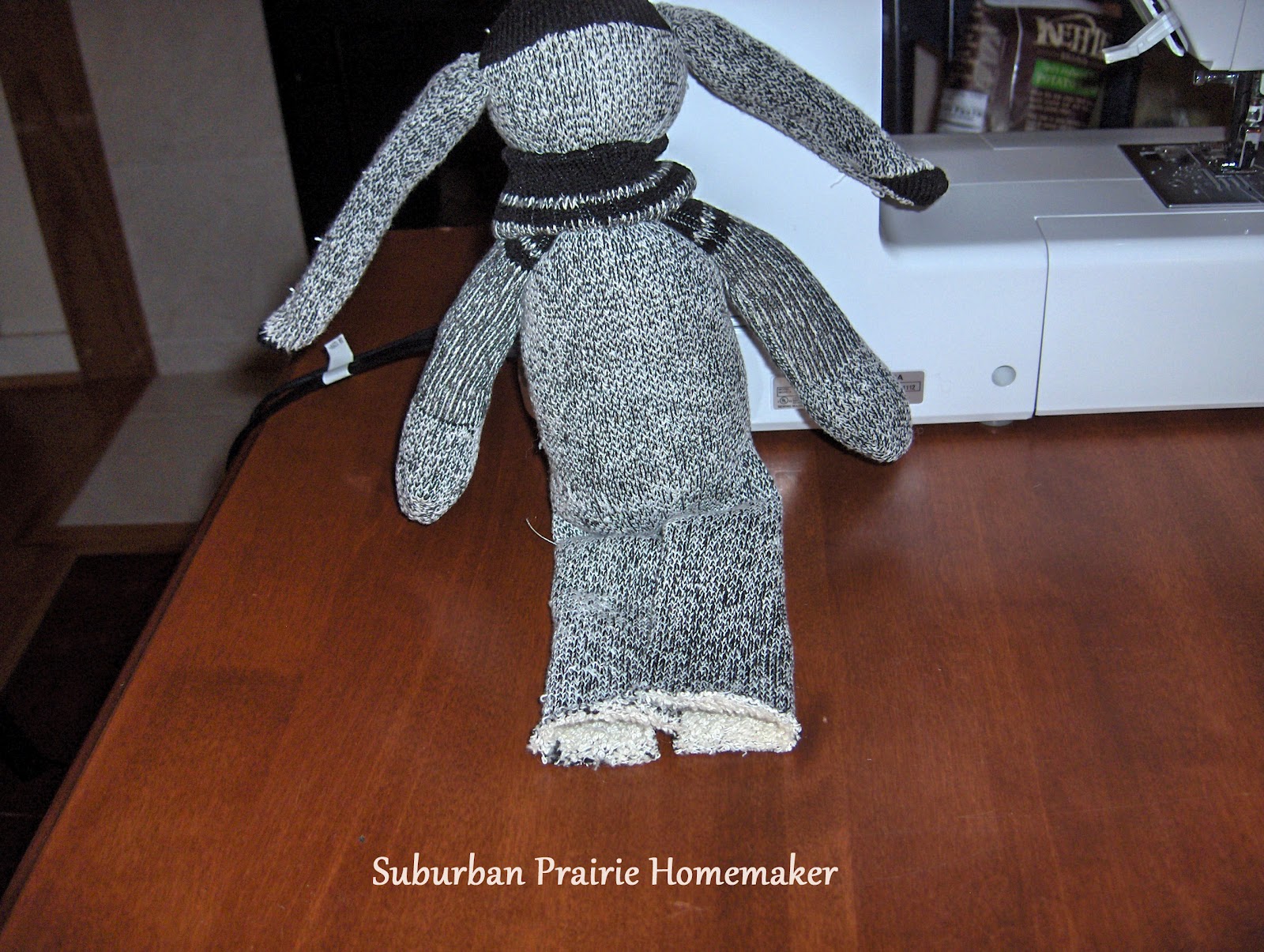
Sock Bunny for The Bunny Project for Harrisburg

He is just so adorable  and easy to make - you'll want to do at least a dozen!


We've named him Righteous.  He reminds me of a skater dude, so he needs a really cool name.  I know he's faceless right now.  Don't worry, I'll take care of his adorable mug later today.  I wanted to get the tutorial up as soon as possible because if you are joining in on the Bonus Craftivism Challenge, you need to mail your bunny (bunnies) no later than Monday, and then you'll need to mail them Priority Mail.  So let's get started!

You will need one pair of size large cotton socks in at least a medium length.  I used men's boot socks I found at Dollar General (2 pair/$4).  I like how they looked like traditional sock monkey socks.  You can use whatever socks you'd like.

You will also need a needle and thread, pins, polyester stuffing, and either a fabric marking pen (this is what I used) or a pencil, and decorations of your choice.  Just remember, for The Bunny Project, if you use buttons, you must label your bun "Ages 4+".

As you put this little guy together, you'll see a lot of similarities to our glove bunny, so if you're new to sewing, this is a great "next-step" project for you.

Here is the template I used as my inspiration for my bunny.  If you like to make sock monkeys or would like to learn, this is the best pattern, with the easiest instructions, I've found.  Obviously, to make a bunny, we're going to do a few things differently, but you can get an idea of how this is all going to go together.

Time is short so let's get started!

Trim the cuff off one sock and save it for later.  Stuff this sock up into the toe, and fill the foot portion roughly 1/3 full.  Run a gathering stitch under the stuffing, starting in the center back and leaving a long starting tail.  When you get all the way around, pull the starting tail and working thread to gather your sock around the stuffing.   Do the criss-cross we did with the glove bunny, and tie TIGHTLY to secure.  Snip threads close to your knot.  This will make the little bunny head.
Now stuff the rest of the foot portion, down to the heel.  Remember your bunny should be able to sit relatively well, but it should also be soft enough to hug.  It's a fine line, and my best suggestion is just to play with it until you are satisfied.  Add more stuffing if you need to, take some out.  You be the judge.
Stitch across the bottom of the body (where the arrow is).  I found this worked best by using my zipper foot on my machine.  You can hand-stitch it if you'd like.  Snip up the middle of the remaining portion of the sock.  This will become the bunny's legs.
Turn the other sock inside out.  Fold it roughly in half, like this photo.  Using your marker or pencil, mark one paw. Use the template above for your guide.  Be sure to mark the straight side along the fold.

Pin through all the layers to mark the paw on the other side, then flip and trace the line that the pins make.  Your paws may not be exactly identical, but they will be close.

For the ears, draw a straight line down from near the center of the toe.  This will give your bun a little tip of color on his/her ears.  You can make your ears as long or short as you'd like.  Repeat the pin and redraw procedure.

After marking, stitch on the lines either on your sewing machine or by hand.  Be sure when you stitch the ears that you leave the bottom open!  After the ears and paws are stitched, cut them free from the sock.  Turn them right side out.  Here you can see one of each right side out, and one still inside out.
Stuff the paws.  Stuff the ears if desired.  I chose not to.  I wanted more of the floppy ear look.  If you want ears that stand up and are more perky, you'll need to stuff them for stability.  Now that my bunny boy is done, I think I should have put a little stuffing  in the tips to help weight them down.  Again, your bunny, your choice.  Be creative.

And now the fun begins!  Stitch the ears and arms onto your bunny.  I liked sewing the ears just below that black spot on the toe.  Kind of like they are sticking out from under a little hat.  I also sewed the arms on a bit high so they'd be covered by that leftover cuff.  Speaking of which - roll the raw edge under.

Slide the cuff over the bunny's head.  It will look like a little turtleneck.
To finish up the legs, start at the bottom of one leg.  Roll in just a little bit of each open side on the long edge, and whipstitch all the way around to the other "foot".  Stuff each leg.  Fold in the bottom edge of each foot a little bit, then run a gathering stitch around.  Pull tight to close, then whipstitch over the top to help keep the opening closed.  Knot thread securely, and cut thread close to knot.

Special Addition:  To make the tail:  cut a circle from leftover sock material.  I used the inside of a canning ring as a template.
Fold the raw edges in a bit and stitch with a gathering stitch.  Add a wee bit of stuffing in the center and pull tight to close.  Stitch to the bunny's little bum.  I stitched mine so the wrong side of the fabric of my sock (which is white and fluffy) was out.  You can sew yours how you like.


So this is where you need to call on your own creativity.  Obviously, this little guy needs a face.  I am going to embroider it.  You can do the button eyes like we did for the glove bunny.  You can add clothing (please remember choking hazzards for little ones and label your bunny appropriately when shipping).  You could do fabric ears.  Just have a lot of fun with it!  Make a bunch!

As of today, I have 5 at my house and a commitment for 1 more.  I'm hoping to get 100 donated.  I need your help to do this!  If you could take an evening this weekend and make a bunny, and ship it out either Saturday or Monday via Priority Mail, I know the children in Harrisburg will appreciate your generosity!

Remember, the bunny goes in a plastic bag to keep it clean.  Label "Ages 3 and Under" or "Ages 4+".
Ship to:
First Church of God
1520 Mchaney Road
Harrisburg, IL 62946

THANK YOU!!!


Photobucket

Sunday, March 25, 2012

Orphaned Glove Bunny Love

Winter is over, and if you have kids, I can promise you that you have a TON of "lonely gloves".  Here's a great project to make with them...


Who would've guessed that we would have 8+ days above 80 degrees in northern Illinois in March.  Seriously.  And with the warmer weather, everyone has been packing up their winter gear, and in this process, maybe you've found a few gloves that are missing their mate.  This post by Tamika at No Time for Tea Parties is a great tutorial of how to make a glove bunny from these "lonely gloves".

These are just so cute, I decided to give it a try myself, and I added a few touches of my own.  Here's what we are making today.
Isn't she sweet?  Tamika's glove bunny makes a perfect "blank canvas" for your inner doll maker.  The whole process is also easy enough to follow that children can get in these too - think of this as a great project for your Brownie or Junior Girl Scout troop to do.  This little cutie is all done with hand sewing, so if you're not comfortable sewing with a machine, you should seriously consider giving this a go.

Here's what you will need:  Stretchy knit gloves.  You can use orphans or pick up some at a dollar-type store pretty cheap.  The top two pairs in the photo below we had as leftovers from a 3-pack.  The bottom 8 pairs (those are all 2-packs), were on sale at our local Dollar General for $2 instead of their usual $3.  That makes these gloves $1/pair.  And since one pair of gloves makes 2 bunnies, that puts our little friends at 50 cents each.  I think I can fit that into my craft budget!  I thought the bright striped gloves would make for some really fun bunnies!
You will also need a sewing needle and a spool of thread that matches your glove, some stuffing (polyester fiberfill or your filling of choice), and an embroidery needle and embroidery floss to give our hare a face.  Other decorations will be described below.  These are entirely optional, but they are a great way to use up items in your stash.

Here is the pair of gloves I decided to use first.

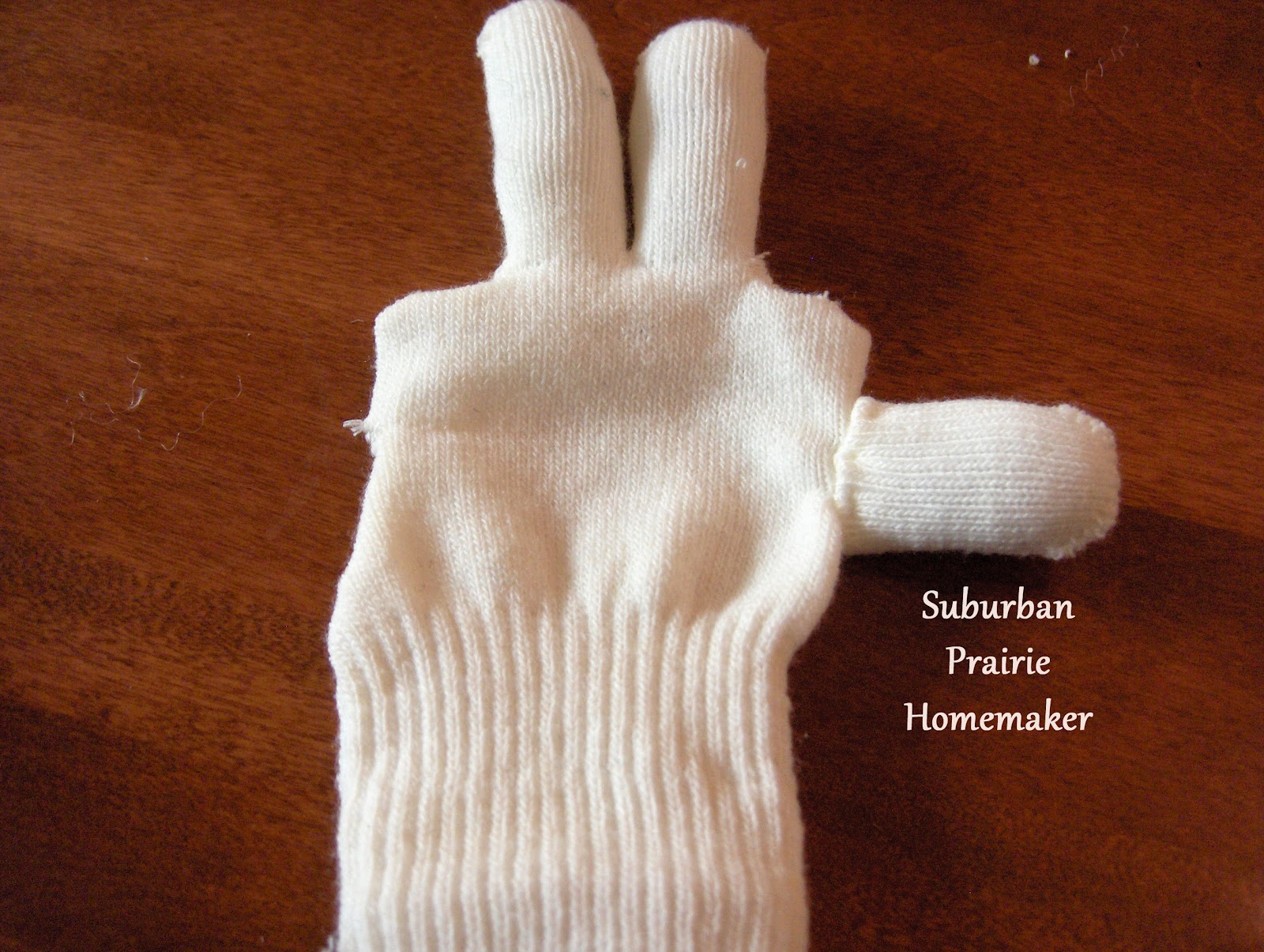
Following Tamika's directions, I trimmed off the thumb (straight line right along the hand portion of the glove), index finger, and pinky.  I also trimmed the thumb piece straight, and made it the same length as the index finger.  You'll see why in just a bit.  Now, turn the glove inside out.

Carefully snip open the cuff.
Like this.

Stitch the finger and thumb holes closed.  I originally used an overcast stitch, but I will use a small running stitch when I make the next one.  It will leave a more finished edge on the outside (and remember how finished edges take a project from homemade to handcrafted?).  Turn your glove back around, right side out.
Stuff the bunnies ears.  If desired, you can run a gathering stitch across the bottom to give them more definition.  Next, stuff the finger and thumb pieces.
Tuck the edges in toward the stuffing.  Sew the arms onto the body about half-way down. Here's arm #1.
And arm #2.
Snip the cuff in half to make two legs.
Stuff the very top part of the body.  Make a long running stitch under this stuffing.  This will make the bunny's neck.  Leave a long tail.  Holding this tail, pull the stitches tight.
To secure, cross the threads in the back, wrap around and cross in the front, then wrap them around to the back again.  Tie tightly, and snip threads close to the knot.
Look at the cute little head!

So I have to apologize here - for this next section, you are going to have to just trust me on the directions.  Not one single photo I took came out clear.  Not one.  Because I'm getting really good at Practice Mondays and Carry-Over Mondays.  Everyone has to be good at something, right?  My camera is a big-picture kind of being.  It can't wrap it's little digital mind around all the small details.

Don't worry, it's not complicated at all.  Just take your time, and go step by step.  If you feel totally confused, feel free to email me (address on contact page).  I'll do my best to help.

Our bunny is feeling hungry - her little tummy is empty.  Stuff the belly portion ABOVE where the cuff/legs meet the future torso.  Repeat the running stitch across the top of the legs, which will also sew up her "personal areas".  If desired, you can run another set of stitching to give the legs more individual definition.  I chose not to do this.

You will alse need to stitch up her inseam.  The knit fabric of the glove should curl in towards the center of each leg.  Use this to your advantage, and stitch this seam shut with the raw edges in.  Overcast stitch here is fine.  Stuff each leg with fiberfill.  Roll the bottom of her bunny feet in towards the stuffing, and using a gathering stitch, sew them shut.  You now have a perfectly usable bunny doll, made by upcycling a glove!  Welcome to the world of dollmaking!

So it was at this point that I wanted to give my new friend some of the personality I knew she had inside.  I started by giving her a tail.  Take the pinky piece you saved and cut it about halfway between where the curve of the fingertip meets the straight side and the bottom cut edge.  That was a mouthful, and hopefully you get the picture.  The photo below shows a practice piece that I cut too short, but I think you can get a good idea.  I actually cut it where the curvy portion meets the straight side, so when you make yours, cut about half-way between where you can see that I cut and that bottom raw edge.  Make sense now?
Add a bit of stuffing, fold in the raw edges and using a gathering stitch, sew it closed.  Then sew it to your bunny's bum.  I like how the tail helps stabilize her body for sitting.


Tamika used french knots to make her bunnies eyes.  If you are making your bunny for a child under the age of 3, I suggest doing the same thing to prevent choking.  I chose to do small buttons because my bunny will go to an older child, and also because I can't make french knots.  You can also do whatever embroidery you'd like, or use felt/fabric.  Whatever works best for you, using what you have on hand.


This is the "design on the fly" portion of our program today...
I also decided to give her some ribbons on her ears.

She needed a dress, so I snagged a piece of pretty floral that would match her eyes (and why I chose that color for the ribbon).  I cut out a rectangle after doing a rough measure to make sure that the scrap would cover Miss Bunny all the way around.
After cutting the rectangle, I pressed all the raw edges under 1/4".  Then I folded the two short ends into the center of the rectangle and pressed.  I cut along these new creases.  Now, I had a front, which was the bigger piece, and two back pieces.  This enables you to have side seams that you can stitch up to Bunny's armpits, as well as make a center back seam that accommodates her fluffy cotton tail.  Match a back piece to a front piece (raw edges together, right sides facing) and measure where the armhole will begin.  Mark that place with a pin.  Start stitching from the hem up to the armhole.  Hide your knot in the hem like this:
Then just do a simple running stitch all the way up to the pin.  Repeat for the other armhole on the other side.
In the back, match the pressed edges and mark for the tail hole with pins, just like before.  This picture shows the right side facing out.  You need the wrong side facing out.  I only used the right side of the fabric so you could see the pins better.  Running stitch from hem to bottom of tail hole, and from top down to tail hole.
Turn your garment right side out and help Miss Bunny into her fancy new dress.  Match up the top of the back to the top of the front.  If you need to, fold the top of the back down a bit more.  Finger crease it.
Hold the shoulders together with pins.  I just matched the edges with no overlap.

Start in the center back, and do a gathering stitch all the way around the neck, pulling as needed to get it to fit.  Knot your thread and trim the ends.
And here she is in her finished dress!
For the record, I went back and did a few extra stitches at the top and bottom of the tail hole, just to be sure it wasn't gappy or "immodest".  This is where I also added the ribbon bow at the neckline.  What you won't see here is the detail I added to the hem.  I did some simple cross-stitching on the bottom of the hem.  Nothing fancy - they weren't even all the same size.  It was just a folk-art-type element that I thought would jazz up the dress a little bit more.  I was right.  You could also add some lace or other trims or stitching.  Or not - your choice.

So what's a new dress without new shoes to go with it?!

I clipped the thumbs off a spare pair of black gloves.
Trim the raw edges so they are straight and even.  Fold the raw edges under, slide them on her little feet, and stitch them to the legs.
Modesty is important, so our little miss needs some underthings.  Start with a scrap of eyelet.
I started in the center back, just under her tail, and stitched it to the body through the bound edge.  When I got back to where I started, I overlapped the edges, and trimmed the curves to match.  Then I stitched the crotch with about 5 or 6 quick stitches, to make it look like real lace bloomers.
Like I said, I was designing on the fly.  When you make your bunny, if you choose to do the bloomers, do them BEFORE you do the dress.  Same for the shoes.

Final touch:  embroidered her little nose and mouth.
Embrace your inner dollmaker and have some fun with these.  Make funky colors, make different clothes, add some hair.  Add pink (or other color) to the ears.  Give her a heart on her belly (like a Raggedy Ann (TM) doll).

Have a great rest of the weekend, everyone!  See you tomorrow!

And PS - be sure you click through on one of the links above to thank Tamika for such a wonderul inspiration piece!
Photobucket